
 fr
fr Home-made LED mask vs. LED treatment in a medical institute: what light doesn't do twice over
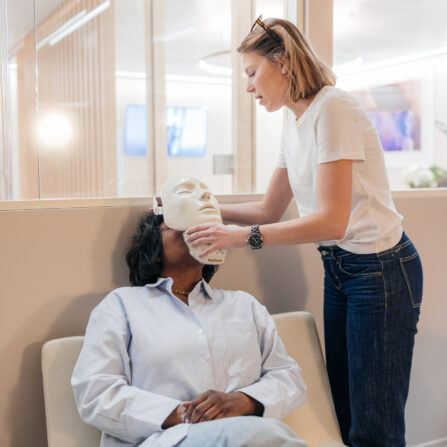
LED masks have invaded our bathrooms. You can see them in Instagram ads, on pharmacy shelves, worn in selfies by influencers with glowing cheeks.
Behind this visibility lies a real technology: the photobiomodulation, Its clinical effects have been documented since the 1990s. But the difference between a device selling for CHF 60 online and a LED treatment performed under medical supervision, the resemblance ends with the shape of the mask. This guide explains why.
What LED therapy really is
Photobiomodulation (or LED light therapy) is based on a simple principle: certain wavelengths of light penetrate skin tissue and trigger targeted biological reactions. Red light (630-670 nm) stimulates collagen production and accelerates cell healing. Blue light (415-430 nm) acts on the bacteria responsible for acne by disrupting their metabolism. Infrared light (760-850 nm) penetrates deeper to reduce inflammation and promote tissue regeneration.
These effects are real. They are documented in the medical literature, reproduced in controlled studies, and have been used for years in dermatology and aesthetic medicine protocols. So the question is not «Does LED work?» but «Under what conditions does it really work?»
Why does power change everything?
A consumer LED light is subject to strict safety standards that limit its irradiance - i.e. the density of power emitted per square centimetre of skin. These limits exist so that anyone can use the device at home without risk, without prior assessment, without a health professional nearby. This is a legitimate protection strategy. But it has a direct cost in terms of effectiveness.
Medical equipment used in institutes is not subject to the same restrictions. Their irradiance can be adjusted according to phototype, the area treated and the clinical indication. The «dose» of light delivered (measured in joules per square centimetre) is calculated to be therapeutically active, not simply harmless.
In concrete terms: a consumer mask typically delivers between 10 and 30 mW/cm². A medical device can deliver between 100 and 200 mW/cm², or even more depending on the protocol. For the same length of session, the energy received by the skin is not comparable.
«The advice of the Forever Institut Clinic»
«Below a certain irradiance threshold, the biological cascade we're trying to trigger simply doesn't happen. It's not that it's less intense, it just doesn't happen. It's the difference between an effective stimulus and a sub-liminal stimulus. At Forever Institut, we work with power densities calibrated for each indication: radiance, post-treatment healing, inflammatory acne».»
- Rachel Polla, CEO
Wavelengths: precision vs. approximation
A good quality LED mask will display its wavelengths on the product sheet. A cheap LED mask will also display its wavelengths, but the accuracy of the actual emission may vary by 20 to 40 nm from the advertised value. For anti-acne blue light, a deviation of 30 nm is enough to take you outside the bactericidal action window. For red light, inaccuracy reduces the depth of penetration and the activation of fibroblasts.
Medical devices use calibrated diodes whose spectral emissions are verified. At Forever Institut, the wavelengths used correspond exactly to the parameters of validated clinical protocols.
Medical supervision: what the device does not replace
An LED mask used at home is applied blindly. Even with good intentions, you don't know whether your skin has a temporary contraindication (recent tan, active inflammation, photosensitising treatment), whether the wavelength chosen corresponds to your actual indication, and whether the exposure time is adapted to your phototype.
During a consultation at Forever Institut, the LED protocol is defined after a skin analysis. The choice of wavelength, power, duration and frequency of sessions are adjusted according to your clinical situation. LED is often combined with other treatments - peeling, mesotherapy, Red light after a peel, for example, significantly accelerates recovery and enhances the effects of the treatment.
It is this coordination that explains the difference in results, much more than the question of power alone.
What the consumer mask can offer and its real limitations
Let's be frank: a consumer LED mask is not without effect. On healthy skin with a compatible phototype and with regular use, the red light can improve radiance, slightly reduce signs of fatigue and support the skin barrier. For someone who doesn't have regular access to a medical institute, it's a maintenance supplement that has its place.
But it does not treat. It does not correct severe acne-prone skin. It does not stimulate deep collagen synthesis. It does not replace a post-procedure protocol. And for darker phototypes (V and VI), some consumer devices present risks of irritation if the blue wavelength is incorrectly calibrated.
The main limit is not technological, but biological: below a certain irradiance threshold, the cellular response is not activated. You can use your mask every day for three months and still remain below this threshold.
What choosing means in concrete terms
If you're looking to maintain the radiance of your skin on a daily basis and you have fair phototype skin with no particular indications, a reliable consumer device (Currentbody, Omnilux, Déesse Pro) can complete your routine.
If you want to treat a specific indication - inflammatory acne, skin slackening, preparation or recovery after an aesthetic treatment - medical LED treatment is the only option that delivers a therapeutically effective intensity under appropriate supervision. This is the position of the doctors at Forever Institut, based on 30 years of clinical practice in aesthetic medicine in Geneva and French-speaking Switzerland.
During your initial consultation, our specialists assess your skin, your goals and your treatment pathway to integrate LED where it is really useful in your protocol - not as an accessory treatment, but as a precision tool.
→ Book a consultation : www.forever-beauty.com/soin/consultation-epilation-laser/
Frequently asked questions about home LEDs and medical LEDs
Does a home-made LED mask really work?
A consumer LED mask can produce effects on radiance and the skin barrier if used regularly on suitable skin. But its power is deliberately limited by safety standards so that it can be used at home without supervision. For clinical indications - acne, sagging, post-treatment recovery - this power is insufficient to trigger the desired biological response. Clinical studies on photobiomodulation have been conducted with irradiances much higher than those of consumer devices.
Which LED wavelength should I choose for anti-ageing?
Red light in the 630-670 nm range is the best documented for its anti-ageing effects: it stimulates fibroblasts, promotes collagen production and improves skin microcirculation. Infrared light (760-850 nm) penetrates deeper and reinforces these effects. For home use, choose a device with certified wavelengths and documented power. For measurable clinical results, a medical institute protocol remains the benchmark.
How many LED sessions do I need at a beauty salon?
The protocol varies according to the indication. For a radiance treatment or to prepare before an event, 3 to 5 sessions spaced a week apart may be sufficient. For a clinical indication such as acne or sagging skin, a protocol of 8 to 10 sessions is generally recommended, followed by a monthly maintenance session. At Forever Institut, LED is often integrated into a broader treatment programme - the results are far superior to those of an isolated LED protocol.
Is LED contraindicated in certain cases?
Yes, the main contraindications include photosensitive epilepsy, taking photosensitising medication (certain antibiotics, topical retinoids, anti-inflammatories), recent or active tanning on the treated area, and certain active skin pathologies. At Forever Institut, a preliminary analysis is carried out during the initial consultation to check that the treatment is suitable for your situation.
Can I use an LED mask at home between two salon sessions?
Yes, in certain cases and with the agreement of your practitioner. Between two skin-relaxation sessions, regular use at home can support the effects of the medical protocol. But the reverse is not true: intensive use at home does not prepare for, or replace, a medical protocol. If you're thinking of buying a mass-market device, mention it during your consultation at Forever Institut - our doctors can guide you towards the relevant technical features for your indication.


