 fr
fr Laser hair removal vs IPL: what are the differences?
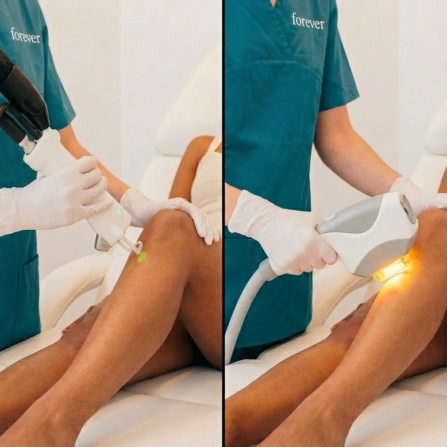
Laser hair removal and IPL hair removal are two photoepilation methods that use light to destroy the hair follicle. Their fundamental difference lies in the nature of the light beam: lasers emit a single, concentrated wavelength, whereas IPL emits a broad spectrum between 500 and 1,200 nm.
Are you hesitating between’permanent laser hair removal and Intense Pulsed Light (IPL)? This is a question we hear regularly at Forever Institut. Although both technologies use light to treat unwanted hair, they have significant technical differences that directly influence their effectiveness, safety and results.
In this article, we explain exactly what distinguishes medical lasers from IPL, why Forever Institut has chosen the latest-generation laser, and how to choose the method best suited to your needs.
What is laser hair removal?
Laser hair removal is a medical technology that uses a monochromatic beam of light, i.e. a single wavelength, to precisely target the melanin in the hair follicle. This highly concentrated light is absorbed by the hair pigment, transformed into heat and then permanently destroys the root without damaging the surrounding tissue.
At Forever Institut, we use Clarity by Lutronic lasers, equipped with two complementary technologies:
- The Alexandrite laser (755 nm): ideal for light to intermediate phototypes (skins I to III). Very effective on fine and medium hair.
- The Nd:YAG laser (1064 nm): designed for darker phototypes (IV to VI) and sensitive areas. Penetrates more deeply and reduces the risk of burning on dark skin.
These medical lasers also incorporate an advanced skin cooling system that protects the epidermis during treatment and makes the session less painful.
What is IPL (intense pulsed light)?
IPL (Intense Pulsed Light) is not strictly speaking a laser. It is a technology that emits a broad spectrum of light, consisting of several wavelengths generally between 500 and 1200 nm.
Unlike lasers, whose light is focused and monochromatic, IPL disperses its light over a wide range. This diffusion makes the treatment less targeted: the light reaches not only the hair, but also adjacent structures such as the epidermis, blood vessels and surrounding pigments.
IPL is often offered in non-medical beauty salons or as a home appliance. Although it can temporarily reduce hair growth, the results are generally less long-lasting and less uniform than those of medical lasers.
The major technical differences between laser and IPL
1. Precision and targeting of the hair follicle
Medical laser The unique wavelength enables ultra-precise targeting of the hair's melanin. Each pulse acts exactly where it should, selectively destroying the follicle.
IPL the broad spectrum disperses the energy over several targets simultaneously (hairs, skin pigments, vessels). This dispersion reduces the effectiveness on the follicle and increases the risk of side effects such as burns or hyperpigmentation.
2. Penetration power and depth
Medical laser The concentrated light penetrates deep down to the hair root, even in areas with deep follicles (bikini line, underarms, back). Medical lasers such as Clarity achieve high fluence, guaranteeing effective destruction.
IPL Dispersed energy limits the depth of penetration. Deep follicles may not be heated enough to be destroyed, which is why results are often incomplete.
3. Safety and adaptation to skin type
Medical laser Thanks to the precise settings and selection of the appropriate wavelength (Alexandrite or Nd:YAG), the laser is perfectly adapted to each phototype. Built-in cooling systems continuously protect the epidermis.
IPL IPL: the broad spectrum increases the risk of skin reactions, especially on dark, tanned or sensitive skin. Darker phototypes (V and VI) are generally contraindicated for IPL, as the technology cannot effectively differentiate between hair melanin and skin melanin.
4. Sustainability of results
Medical laser According to Forever Institut's clinical protocol, developed over more than 25 years of practice in Geneva and Nyon, laser hair removal offers a permanent reduction of 80 to 90 % in hair growth after a complete protocol of 7 to 10 sessions. Treated hair does not grow back, or only occasionally, particularly in cases of hormonal upheaval.
IPL The results are temporary to semi-permanent. Regrowth is frequent after a few months, requiring regular maintenance sessions. IPL slows down hair growth but does not eliminate it permanently.
Comparison of light hair removal technologies - Forever Institut, Geneva.
| Criteria | Alexandrite laser (755 nm) | Nd:YAG laser (1064 nm) | Professional IPL | Domestic IPL |
|---|---|---|---|---|
| Type of light | Monochromatic | Monochromatic | Broad spectrum (500-1200 nm) | Broad spectrum (500-1200 nm) |
| Compatible phototypes | I to III | IV to VI | I to IV | I to III only |
| Penetration depth | High | Very high | Limited | Very limited |
| Details of the follicle | Maximum | Maximum | Partial | Low |
| Sustainability of results | Definitive (80-90 %) | Definitive (80-90 %) | Semi-permanent | Temporary |
| Number of sessions | 7 à 10 | 7 à 10 | 10 to 15 + interviews | Continuous |
| Medical supervision | Yes - Forever Institut | Yes - Forever Institut | Not required | Not required |
| Risk on dark skin | Low | Very low | High | Very high |
| Available from Forever Institut | Yes | Yes | No | No |
Why has Forever Institut chosen medical lasers?
Forever Institut has been using the most advanced laser hair removal technologies for over 25 years. Our choice of the Clarity by Lutronic medical laser is based on rigorous scientific and clinical criteria:
- Proven effectiveness: thousands of patients successfully treated in our clinics in Geneva, Nyon and Lausanne.
- Maximum safety: integrated cooling systems, personalised settings and constant medical supervision.
- Adaptability: two wavelengths (Alexandrite and Nd:YAG) to treat all phototypes in complete safety.
- Patient comfort: quick, painless sessions with no social eviction.
- Lasting results: permanent reduction in hair growth after the full protocol.
We have deliberately avoided IPL because of its technical limitations and less predictable results. Our commitment to excellence and patient satisfaction drives us to use only the highest-performing medical equipment.
How do you choose between laser and IPL?
The choice between medical laser and IPL depends on your objectives, your skin type and your expectations in terms of results.
Choose a medical laser if :
- You're looking for permanent, long-lasting hair removal.
- You have matt, dark or sensitive skin.
- You want to treat deep or sensitive areas (full bikini line, back, chest).
- You give priority to safety and medical supervision.
- You want an effective treatment from the very first sessions.
IPL may be suitable if :
- You have very light hair growth and fair skin (phototypes I to III).
- You accept temporary results requiring regular maintenance.
- You're looking for a cost-effective short-term solution (beware: the total cost over several years may exceed that of the laser).
At Forever Institut, we systematically recommend medical lasers to guarantee optimal, safe and long-lasting results. During your initial consultation, Our specialists will assess your situation and guide you towards the most appropriate protocol.
Frequently asked questions about laser vs IPL hair removal
Is laser really more effective than IPL?
Yes, the medical laser offers superior precision and power thanks to its focused monochromatic light. Unlike IPL, which disperses energy over a wide spectrum, the laser targets the hair's melanin exclusively, guaranteeing effective destruction of the hair follicle. According to Forever Institut's clinical protocol, based on over 25 years' experience, laser hair removal offers a permanent reduction of 80 to 90 % in hair growth after a complete protocol, compared with temporary results with IPL.
Why is IPL cheaper than laser?
IPL is cheaper to buy and maintain, which is reflected in the prices on offer. However, this initial saving is deceptive: as the results are not long-lasting, you will need to multiply the number of maintenance sessions over a period of years. In the long term, the total cost of IPL can exceed that of a full laser protocol, which offers definitive results.
Does IPL work on all skin types?
No. IPL is contraindicated on darker phototypes (V and VI) because of the high risk of burns and hyperpigmentation. The broad light spectrum does not effectively differentiate between the melanin in the hair and that in the skin. The Nd:YAG medical laser, on the other hand, is specifically designed to treat dark skin in complete safety.
Can I use an IPL device at home?
Home IPL devices do exist, but their power is deliberately limited for safety reasons. Although they can temporarily slow hair regrowth, they cannot achieve permanent hair removal. What's more, without a prior medical diagnosis, you run the risk of using the device on unsuitable skin (tanned, reactive, dark phototype), increasing the risk of side-effects.
Is medical laser treatment painful?
No. Thanks to the cooling systems built into the Clarity by Lutronic lasers used at Forever Institut, the session is virtually painless. You may feel a slight tingling sensation, comparable to a rubber band on the skin, but the sensation is perfectly tolerable. An anaesthetic cream can be applied one hour before the treatment if you are particularly sensitive.
How many laser sessions are needed?
On average, 7 to 10 sessions are required. According to Forever Institut's clinical protocol, this number makes it possible to achieve an 80 to 90 % reduction in hair growth in most treated areas. The exact number depends on the area treated, the type of hair and your phototype. The first sessions already show a significant reduction in hair growth. An annual maintenance session may be recommended for optimal long-term results.
Can all areas be treated with laser?
Yes, the medical laser can treat all areas of the body: face (upper lip, chin, cheeks), body (underarms, arms, legs, back, torso, stomach) and bikini line (classic, low-cut or full). Clarity technology allows you to adapt the settings to suit each area, even the most sensitive.
Are there any contraindications to laser treatment?
The main contraindications include pregnancy (abdomen and bikini line areas), recent tanning, active skin lesions, taking photosensitising medication and a history of melanoma. During the initial consultation, our specialists systematically check that the laser treatment is suitable for your situation.
What is the difference in cost between laser and IPL?
An IPL session is generally 30 to 50 % less expensive than a medical laser session. However, according to the follow-up of our patients in Geneva and Nyon, IPL requires an average of 10 to 15 initial sessions and maintenance every 3 to 6 months - whereas a complete laser protocol of 7 to 10 sessions produces lasting results without major maintenance. In the end, over 5 to 10 years, the total cost of IPL can exceed that of a full laser protocol, which offers definitive results without major maintenance. At Forever Institut, we offer a «half-price» subscription card enabling you to take advantage of 5-session subscriptions at -50 % for one year.
How do I make an appointment for a consultation?
You can book your consultation at one of our clinics in Geneva or Nyon directly online at www.forever-beauty.com or by telephone. The initial consultation enables us to analyse your skin, your hairiness and your objectives in order to define the most appropriate protocol. A laser test can be carried out immediately to check your skin's reaction and validate the parameters.
Article written by  Dr Luigi L. Polla
Dr Luigi L. Polla has been a dermatologist FMH since 1984 and founder of Forever Institut, a pioneering centre for aesthetic medicine in Geneva since 1997. He trained at Harvard Medical School's Wellman Laboratory with Professors Fitzpatrick, Parrish and Rox Anderson - the fathers of selective photothermolysis, the principle on which all the medical lasers used today are based. He introduced the first Candela depilatory lasers, Cynosure's PicoSure and CoolSculpting to Switzerland. Co-founder of the Swiss Society of Aesthetic Medicine, member of the AAD and the EADV.


