
 fr
fr How many sessions are needed to remove a laser tattoo?
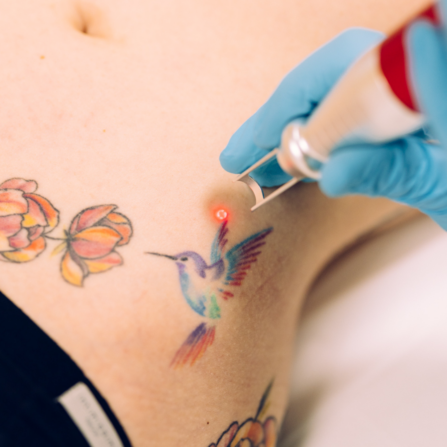
You're thinking of having a tattoo removed, and you want to know how many sessions you'll need before your skin is clear. This is the first question asked by the vast majority of people who come to Forever Institut for a tattoo removal. laser tattoo removal and that's a legitimate question, because the answer is never the same from one case to the next.
Laser technology has advanced considerably in recent years. Today, the latest generation of medical lasers can remove tattoos with a precision and effectiveness that older techniques could not achieve. But the number of sessions required depends on a number of clearly identified factors: the colour of the ink, the size of the tattoo, how long it has been there, the density of the ink and your skin type.
In this article, we detail each of these criteria to help you understand what determines the duration of your protocol and what you can reasonably expect from the first sessions.
How does a laser remove a tattoo?
The principle is based on the selectivity of laser light. The beam emits very short, very powerful pulses that target the ink particles encysted in the dermis. Under the effect of heat, these particles fragment into micro-particles that the immune system can then eliminate naturally.
Each session reduces the concentration of ink in the skin. The discolouration is progressive: the tattoo fades with each session, until it disappears or becomes imperceptible. The interval between two sessions - generally six to eight weeks - gives the body time to evacuate the ink fragments and the skin time to regenerate.
| 💬 The opinion of Dr Luigi L.Polla«The response to laser treatment depends as much on the skin as on the ink. A tattoo made with professional quality ink and several colours will require a longer protocol than a monochrome tattoo with black ink. During the initial consultation, we assess these parameters precisely in order to establish a realistic estimate of the number of sessions required». - Dr. Luigi L. Polla |
How many sessions on average?
The usual range is between 5 and 15 sessions, depending on the case. A small amateur tattoo in black ink on light skin can be removed in 4 to 6 sessions. On the other hand, a large polychrome tattoo done by a professional using dense coloured inks may require 12 to 15 sessions, sometimes more.
This variability is explained by the following factors, which are detailed below.
Criteria for determining the number of sessions
1. The colour of the ink
This is the most important factor. Black ink absorbs all wavelengths of light, so it responds most quickly and completely to lasers. Red, orange and yellow inks are more selective: they require specific wavelengths and respond less well to standard lasers.
Green and blue inks are the most resistant. Some pigment formulations used in professional studios contain compounds that absorb laser light poorly, multiplying the number of sessions required.
2. The size and complexity of the tattoo
The size of the tattoo is not related to the effectiveness of tattoo removal. The density of the line does, however, play a role: a very heavy tattoo, with saturated areas of fill, will require more sessions than a tattoo with a fine line. The quality of the ink will also play an important role in the effectiveness of tattoo removal: inferior quality ink will take longer to remove.
3. Age of the tattoo
Counter-intuitively, an old tattoo is not always harder to remove. Over time, the body has already begun to naturally fragment some of the ink. A recent tattoo, less than a year old, has ink that is not yet well stabilised in the dermis and so may respond better to laser treatment.
In both cases, the protocol can be adapted. A tattoo that is more than ten years old can sometimes be treated in fewer sessions than one that is five years old, simply because some of the pigmentation has already faded.
4. Quality and type of ink
Tattoos made by amateurs or with low-quality inks are often easier to remove. The ink is generally less dense, deposited less deeply in the dermis, and more homogeneous. A professional studio tattoo, on the other hand, uses concentrated, multiple inks deposited with precision - which gives a superior aesthetic result, but makes tattoo removal more complex.
5. Your skin type
On fair skins (phototypes I to III), the contrast between the ink and the skin is maximal. The laser can work at higher fluences, which improves effectiveness at each session. On dark or matt skins (phototypes IV to VI), it is important to adjust the wavelength and to treat the tattoo with Nd:YAG to avoid any risk of hyperpigmentation.
6. Location on the body
Blood and lymph circulation in the treated area influences the speed at which ink fragments are eliminated. Tattoos on the extremities (ankles, feet, hands) often respond more slowly than those near the trunk, where circulation is more active.
Summary table: criteria and estimated impact
| Criteria | Impact on the number of sessions |
| Black or grey ink | The most effective - absorbs all wavelengths. 7 to 10 sessions in general. |
| Red, orange and yellow ink | More difficult to treat - requires specific wavelengths. 9 to 15 sessions, bearing in mind that the final result for orange and yellow inks is not guaranteed. |
| Green or blue ink | Resistant to standard laser treatment. Often more than 12 sessions, depending on density. |
| Recent tattoo (< 1 year) | Ink not yet stabilised - easier to fragment. Possibly faster results. |
| Old tattoo (> 5 years) | The ink is stabilised but may already be partially degraded naturally. |
| Fair skin (phototype I-III) | Better contrast between ink and skin - optimal laser response. |
| Matt or dark skin (IV-VI) | Adjusted wavelength, more progressive protocol. Risk of hyperpigmentation |
| Large surface area (> 10 cm) | Larger surface area = more passes required. Longer sessions. |
| Ink quality | The better the quality of the ink, the better it is eliminated |
| Depth & density of the tattoo | The deeper and denser the tattoo is anchored in the skin, the more sessions are required. |
Which laser technology is best for tattoo removal?
Not all lasers are created equal. For tattoo removal, the current reference technology is the picosecond laser, and this is precisely the equipment used at Forever Institut.
Le picosecond laser emits pulses 100 times shorter and more powerful than previous generation lasers. This infinitesimal pulse duration, of the order of a picosecond, or a thousandth of a billionth of a second, breaks up the ink particles into much smaller microparticles than with a conventional Q-switched laser. The immune system then eliminates them more quickly, which translates into better results on stubborn colours and resistant inks that are resistant to previous technologies.
During the initial consultation, our specialists determine the wavelength best suited to the dominant colour of your tattoo and your phototype. This is a decisive stage: selecting the wrong wavelength can be ineffective on certain colours, or cause avoidable skin reactions.
Make an appointment for a tattoo removal consultation
Each tattoo is unique. The only way to get an accurate estimate of the number of sessions - and therefore the cost and total duration of the treatment - is to consult our doctors.
At Forever Institut, the initial consultation enables us to analyse your tattoo, assess the colours present, determine your phototype and draw up a personalised protocol. A laser test can be carried out on the same day.
Our clinics in Geneva, Lausanne and Nyon offer laser tattoo removal consultations. Book an appointment directly online at www.forever-beauty.com or by telephone.
Frequently asked questions about laser tattoo removal
In the vast majority of cases, yes. Tattoos with black or grey ink on fair skin disappear completely after a full protocol. Multi-coloured tattoos or very resistant inks (some green, fluorescent yellow) may leave a slight residual trace - almost invisible in everyday life - rather than disappear completely. That's why an honest prior assessment is essential: our doctors will give you a realistic estimate as early as the initial consultation.
Prices are based on estimates, from CHF 150 per session, depending on the size and complexity of the tattoo. Forever Institut offers a Tattoo Removal Card for CHF 200, which is valid for 2 years and entitles the holder to a discount of 30 % on all laser tattoo removal sessions. For a protocol of several sessions and an estimate of more than 250CHF, this card represents a significant saving from the second session onwards.
Yes, with the right equipment and an appropriate protocol. Matt or dark skins (phototypes IV to VI) require specific wavelengths and reduced fluence parameters to avoid the risk of hyperpigmentation. The protocol is generally more gradual, which may lengthen the overall duration slightly - but the treatment remains possible and safe within the framework of medical care.
The main contraindications are: pregnancy, recent tanning or sun exposure on the treated area, taking photosensitising or melanin-stimulating medication, active skin lesions or local infections, and certain dermatological antecedents. During the consultation, our doctors systematically check that there are no contraindications before starting any protocol.
Absolutely. The treated skin is temporarily weakened and very sensitive to UV rays. Exposure to the sun on an area undergoing tattoo removal can cause hyperpigmentation or slow down the response to the treatment. Sun protection factor 50+ is essential throughout the procedure, including between sessions.
Yes, the laser can be applied to a specific area of the tattoo to remove a detail or a name, or to prepare the skin for covering. This approach is increasingly popular, particularly for correcting a tattoo without removing it entirely. The protocol is identical, but limited to the area concerned.


